
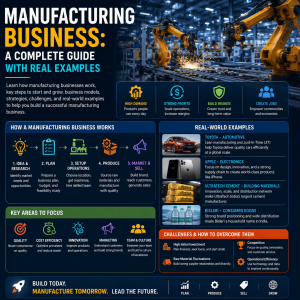
Manufacturing Business: A Complete Guide with Real Examples
Manufacturing businesses are the backbone of every economy. They transform raw materials into finished goods that people use daily. From automobiles and electronics to packaged foods and furniture manufacturing, the manufacturing sector drives economic growth, creates jobs, and powers industrial development worldwide.
Today, the modern manufacturing sector is rapidly evolving with technologies like industrial automation, artificial intelligence, robotics, and Industry 4.0 solutions transforming traditional production systems into smart factories.
In this blog, we will explore the manufacturing process, modern manufacturing technology, industrial engineering practices, and the future of product manufacturing in the digital age.
What is a Manufacturing Business?
A manufacturing business is a company that converts raw materials into finished goods using machines, labor, and advanced production systems.
The manufacturing process involves several stages including:
- Product design
- Raw material sourcing
- Production planning
- Assembly and quality control
- Packaging and distribution
The finished products are then sold to wholesalers, retailers, or consumers.
The manufacturing sector includes industries such as:
- Automobile manufacturing
- Electronics manufacturing
- Textile production
- Furniture manufacturing
- Food processing
- Chemical manufacturing
Modern product manufacturing focuses heavily on efficiency, quality, and automation.
Key Features of the Manufacturing Sector
The manufacturing sector operates through a combination of labor, machinery, technology, and operational management.
Important features include:
Production-Oriented Operations
Manufacturing businesses focus on large-scale product manufacturing and efficient production systems.
Use of Industrial Machinery
Advanced industrial machinery is essential for increasing productivity and maintaining product quality.
Industrial Engineering Systems
Industrial engineering helps optimize workflows, reduce waste, and improve operational efficiency.
Quality Control
Quality testing ensures that products meet industry standards and customer expectations.
Manufacturing Technology Integration
Modern manufacturing technology improves speed, accuracy, and overall business performance.
Types of Manufacturing Businesses
Different industries use different manufacturing methods depending on product demand and production scale.
1. Job Production
Products are manufactured individually according to customer requirements.
Example:
- Custom furniture manufacturing
- Specialized machine production
This method focuses on personalized product manufacturing.
2. Batch Production
Products are produced in groups or batches.
Examples include:
- Bakery products
- Garments
- Cosmetics
Batch manufacturing improves flexibility while maintaining production efficiency.
3. Mass Production
Mass production involves manufacturing large quantities of identical products.
Examples:
- Automobiles
- Smartphones
- Consumer electronics
Industrial automation and industrial machinery are heavily used in mass production systems.
4. Continuous Production
Production runs continuously with minimal interruption.
Examples:
- Oil refineries
- Chemical plants
- Steel industries
Continuous manufacturing depends on advanced manufacturing technology and automation systems.
Importance of Industrial Automation in Manufacturing
Industrial automation has completely transformed modern factories.
Through industrial automation, machines and software systems perform production tasks automatically with minimal human involvement.
Benefits of industrial automation include:
- Faster production speed
- Reduced operational costs
- Improved product quality
- Higher efficiency
- Better workplace safety
Factories using industrial automation systems can produce products faster and more accurately.
AI in Manufacturing and Smart Factories
AI in manufacturing is becoming one of the biggest innovations in the industrial world.
Artificial intelligence helps manufacturers:
- Predict machine failures
- Improve production planning
- Reduce waste
- Analyze customer demand
- Increase efficiency
AI in manufacturing also supports predictive maintenance and intelligent supply chain management.
Combined with Industry 4.0 technologies, AI-powered smart factories are reshaping the future of product manufacturing.
Understanding Industry 4.0 in Modern Manufacturing
Industry 4.0 refers to the digital transformation of manufacturing through advanced technologies such as:
- Artificial intelligence
- Internet of Things (IoT)
- Robotics
- Cloud computing
- Data analytics
Industry 4.0 enables factories to become smarter, faster, and more connected.
Benefits of Industry 4.0 include:
- Real-time production monitoring
- Automated decision-making
- Improved operational efficiency
- Reduced manufacturing errors
- Better customer customization
The adoption of Industry 4.0 is now essential for staying competitive in the global manufacturing sector.
Role of Industrial Engineering in Manufacturing
Industrial engineering plays a critical role in improving production systems and operational performance.
Industrial engineering focuses on:
- Workflow optimization
- Productivity improvement
- Cost reduction
- Resource management
- Quality enhancement
Manufacturing companies use industrial engineering techniques to maximize efficiency while reducing waste.
Lean Manufacturing and Waste Reduction
Lean manufacturing is a production strategy focused on reducing waste and improving efficiency.
The goal of lean manufacturing is to deliver maximum value while minimizing unnecessary processes.
Lean manufacturing principles include:
- Continuous improvement
- Efficient resource usage
- Faster production cycles
- Inventory reduction
- Better quality control
Many successful manufacturing companies use lean manufacturing systems to increase profitability and productivity.
Importance of Industrial Machinery in Product Manufacturing
Industrial machinery is the foundation of modern manufacturing operations.
Advanced industrial machinery improves:
- Production speed
- Accuracy
- Product consistency
- Safety standards
Examples of industrial machinery include:
- CNC machines
- Robotic arms
- Conveyor systems
- Packaging equipment
- Assembly line systems
Efficient industrial machinery helps manufacturers meet increasing market demand.
Furniture Manufacturing and Growing Consumer Demand
Furniture manufacturing is one of the fastest-growing sectors within the manufacturing industry.
Modern furniture manufacturing combines:
- Automated cutting systems
- Smart production technology
- Custom product design
- Sustainable materials
The rise of e-commerce and interior design trends has increased demand for customized furniture manufacturing solutions.
Examples of Successful Manufacturing Companies
Tata Motors
A leading automobile manufacturer known for innovation and affordable vehicles.
Reliance Industries
A major player in petrochemicals, refining, and industrial manufacturing.
Apple
Known globally for advanced product manufacturing of iPhones, MacBooks, and other premium electronics.
Nestlé
A global leader in food and beverage manufacturing.
Steps to Start a Manufacturing Business
Starting a manufacturing business requires proper planning and investment.
1. Choose a Product
Select a product with strong market demand and growth potential.
2. Develop a Business Plan
Include:
- Investment estimates
- Manufacturing process
- Marketing strategy
- Production goals
3. Invest in Manufacturing Technology
Modern manufacturing technology improves productivity and competitiveness.
4. Purchase Industrial Machinery
Choose efficient industrial machinery based on production requirements.
5. Hire Skilled Workers
Skilled labor ensures better quality and operational efficiency.
6. Implement Lean Manufacturing
Adopt lean manufacturing methods to reduce waste and improve profits.
7. Use Industrial Automation
Industrial automation helps scale production efficiently.
Challenges in the Manufacturing Sector
Despite its opportunities, the manufacturing sector faces several challenges:
- High initial investment
- Rising operational costs
- Supply chain disruptions
- Technology adaptation
- Global competition
Businesses that invest in manufacturing technology and Industry 4.0 solutions can overcome these challenges more effectively.
Future of Manufacturing Business
The future of manufacturing is driven by innovation and digital transformation.
Key future trends include:
- AI in manufacturing
- Smart factories
- Industry 4.0 integration
- Sustainable production systems
- Robotics and automation
- Advanced industrial engineering
Companies adopting advanced manufacturing technology and industrial automation will lead the next generation of global industrial growth.
Conclusion
The manufacturing sector is essential for economic growth, industrial development, and innovation. From small businesses to global corporations, manufacturing powers industries and creates millions of jobs worldwide.
Modern manufacturing businesses now rely on:
- Industrial automation
- AI in manufacturing
- Industrial engineering
- Lean manufacturing
- Industry 4.0 systems
- Advanced industrial machinery
Whether it is furniture manufacturing, electronics production, or automobile assembly, the future of product manufacturing depends on technology, efficiency, and innovation.
Thank You Read
Guess the Image
Winner Prizes
- Choose the Next Blog Topic – The winner gets the opportunity to suggest or choose the topic for an upcoming TechMatrix blog post.
- First Comment After Winning – The winner gets special recognition as the First Comment Winner on the next featured blog post.
- Get Featured as a Winner – Your name or username can be displayed in our Winner Section on the website.
Play → Comment → Win → Get Featured → Suggest the Next Topic!

Question: Can you guess this car company from its logo?
Options:
- A) Jaguar
- B) BMW
- C) Audi
- D) Mercedes-Benz