
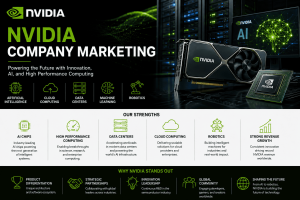
NVIDIA Company Marketing: How NVIDIA Became a Global Technology Leader
Introductionto NVIDIA and Artificial Intelligence
NVIDIA has transformed from a graphics technology company into one of the world’s most important technology companies. Founded in 1993, the company initially became widely known for graphics processing units (GPUs) used in gaming and professional graphics. Today, NVIDIA is closely associated with artificial intelligence, machine learning, data centers, robotics, and high-performance computing.
The company’s success is not based only on powerful hardware. NVIDIA has built a broad technology ecosystem that combines hardware, software, developer tools, partnerships, and platforms. Its marketing strategy communicates the value of this ecosystem while positioning NVIDIA as a leader in the rapidly growing AI economy.
NVIDIA Company Background and AI Chips
NVIDIA’s early growth was strongly connected to graphics processing. The NVIDIA graphics card became popular among gamers, designers, engineers, and other users who needed powerful visual computing.
Over time, NVIDIA recognized that GPUs could perform highly parallel calculations useful beyond graphics. This opened opportunities in scientific computing and eventually artificial intelligence.
The company’s AI chips are now designed for demanding workloads such as AI model training, inference, simulation, and data analysis. This shift helped NVIDIA move from primarily serving gamers to serving businesses, researchers, cloud providers, and governments.
From NVIDIA Graphics Card to AI Infrastructure
The NVIDIA graphics card remains an important part of the company’s identity, but its broader strategy now focuses on accelerated computing. This expansion is an example of successful product development and market diversification.
NVIDIA Marketing Strategy and Product Differentiation
One of NVIDIA’s strongest marketing advantages is product differentiation. Rather than competing only on traditional hardware specifications, NVIDIA promotes a complete technology platform.
Its products are presented as solutions for specific workloads, including AI development, scientific research, visualization, gaming, and enterprise computing.
Product Differentiation Through Innovation
NVIDIA emphasizes technological performance, software compatibility, developer support, and ecosystem advantages. This allows the company to communicate why its products can be valuable for customers with demanding computing requirements.
Marketing based on product differentiation also helps NVIDIA appeal to different audiences. Gamers may focus on graphics performance, while businesses may be more interested in AI infrastructure and data processing.
Artificial Intelligence and Machine Learning Leadership
The growth of artificial intelligence has created enormous demand for accelerated computing. Training and operating sophisticated AI models requires substantial computing power, creating a major market opportunity for NVIDIA.
Machine learning applications can involve processing enormous datasets and performing complex calculations. GPUs are well suited to many of these workloads because they can perform large numbers of calculations in parallel.
Machine Learning and NVIDIA Technology
NVIDIA supports machine learning through hardware, software libraries, development platforms, and tools. This ecosystem makes it easier for developers and researchers to build and optimize AI applications.
The company’s strategy is therefore broader than selling individual AI chips. It aims to provide the infrastructure required to develop, train, deploy, and scale AI systems.
NVIDIA Data Centers and Cloud Computing
The expansion of data centers has become one of the most important parts of NVIDIA’s business. Modern AI applications require large-scale computing infrastructure, and companies need powerful systems to train and operate AI models.
NVIDIA provides GPUs, networking technologies, systems, and software that can be integrated into enterprise and hyperscale data centers.
Cloud Computing Partnerships
Cloud computing companies use NVIDIA technology to provide customers with access to accelerated computing resources. Instead of purchasing and maintaining expensive hardware themselves, businesses can access computing capacity through cloud platforms.
This creates a powerful relationship between NVIDIA and the cloud computing industry. As demand for AI services increases, the need for high-performance infrastructure can also increase.
High Performance Computing and Enterprise Growth
High performance computing is another important area where NVIDIA has expanded its presence. Researchers and organizations use accelerated computing for scientific simulations, engineering, weather modeling, drug discovery, financial analysis, and other computationally demanding tasks.
NVIDIA’s marketing connects these applications to a broader message: accelerated computing can help organizations solve complex problems faster.
High Performance Computing Innovation
The company’s combination of GPUs, networking, software, and development tools helps create complete computing platforms rather than isolated components.
This platform approach supports NVIDIA’s position in enterprise technology and strengthens its reputation for innovation.
NVIDIA Robotics and Autonomous Technology
NVIDIA is also active in robotics and autonomous systems. Modern robots require powerful computing to process sensor data, understand environments, plan movements, and respond to changing situations.
AI-powered robotics can be used in manufacturing, logistics, healthcare, research, and other industries.
Robotics and Artificial Intelligence
The combination of robotics and artificial intelligence creates opportunities for machines to perform increasingly complex tasks. NVIDIA provides computing platforms and software designed to support developers building intelligent machines.
This market expansion gives NVIDIA another way to apply its accelerated computing technology beyond gaming and traditional data centers.
NVIDIA Revenue and Business Growth
NVIDIA’s transformation into an AI infrastructure company has significantly changed its business profile. NVIDIA revenue has increasingly reflected demand for data-center computing and AI infrastructure in addition to its traditional gaming business.
The company’s ability to serve multiple markets provides opportunities for continued growth. Gaming, professional visualization, automotive technology, robotics, AI, and enterprise computing all contribute to a diversified technology ecosystem.
How NVIDIA Revenue Supports Innovation
Revenue growth allows NVIDIA to continue investing heavily in research and development. This creates a cycle in which technological innovation supports new products, new products create market opportunities, and growing demand supports additional research.
This relationship between NVIDIA revenue and investment in innovation is an important part of the company’s long-term strategy.
NVIDIA Marketing Through Strategic Partnerships
Partnerships are another major component of NVIDIA’s marketing strategy. The company works with cloud providers, software developers, universities, automotive companies, manufacturers, and other technology organizations.
These partnerships help demonstrate how NVIDIA technology can be applied in real-world environments.
Building a Global Technology Ecosystem
Instead of marketing its products as standalone components, NVIDIA promotes an ecosystem involving hardware, software, developers, cloud infrastructure, and applications.
This strategy increases the visibility of NVIDIA technology across different industries and helps strengthen customer relationships.
NVIDIA and the Semiconductor Industry
NVIDIA operates within the highly competitive semiconductor industry, where companies compete through technological performance, design capabilities, manufacturing partnerships, and software ecosystems.
Unlike companies that manufacture every component themselves, NVIDIA focuses heavily on chip design and platform development while relying on manufacturing partners for semiconductor production.
Competition in the Semiconductor Industry
The semiconductor industry includes many powerful companies competing across CPUs, GPUs, AI accelerators, memory, networking, and specialized processors.
NVIDIA’s competitive advantage comes from combining powerful processors with software, developer tools, networking, and a broad ecosystem. This makes its market position more difficult to evaluate through hardware specifications alone.
Challenges Facing NVIDIA
Despite its success, NVIDIA faces several challenges. Competition in AI computing continues to increase, while customers are also developing their own specialized processors.
The company must continue investing in artificial intelligence, AI chips, software, and high performance computing to maintain its technological position.
Supply-chain requirements, semiconductor manufacturing capacity, energy consumption, changing regulations, and rapid technological development can also affect the company’s future.
Maintaining product differentiation will therefore remain important as competitors introduce new technologies.
Conclusion: NVIDIA’s Future as a Technology Leader
NVIDIA’s journey from a graphics-focused company to a global technology leader demonstrates the power of innovation, strategic positioning, and effective product differentiation.
The NVIDIA graphics card established the company’s reputation in visual computing, while investments in AI chips, machine learning, and artificial intelligence opened much larger markets. Its growing role in data centers, cloud computing, robotics, and high performance computing has further expanded its technology ecosystem.
Thank You Read
Mystery Quiz
Winner Prizes
- Choose the Next Blog Topic – The winner gets the opportunity to suggest or choose the topic for an upcoming TechMatrix blog post.
- First Comment After Winning – The winner gets special recognition as the First Comment Winner on the next featured blog post.
- Get Featured as a Winner – Your name or username can be displayed in our Winner Section on the website.
Play → Comment → Win → Get Featured → Suggest the Next Topic!
- 🔎 Mystery 4: The Competitor Secret
Clue:
A competitor suddenly starts attracting many customers.
Question: What should you investigate?
A. Competitor strategy
B. Office decoration
C. Employee lunch
D. Company vehicle
