
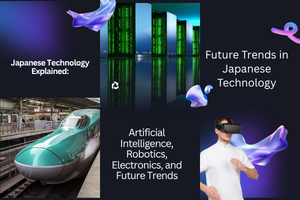
Japanese Technology Explained: Artificial Intelligence, Robotics, Electronics, and Future Trends
Introductionto Japanese Technology
Japan has long been recognized for its strong contribution to science, engineering, manufacturing, and innovation. From advanced automobiles and consumer electronics to industrial robots and artificial intelligence, Japanese technology has influenced industries around the world.
Japan’s technology sector combines precision engineering with research and practical applications. Today, companies and research institutions are developing advanced technology in areas such as robotics, AI technology, semiconductors, cloud computing, electric mobility, and smart infrastructure.
The country’s focus is increasingly moving toward connected systems, intelligent machines, sustainable transportation, and future technology that can address challenges such as an aging population, labor shortages, energy efficiency, and urban development.
Artificial Intelligence and AI Technology in Japan
Artificial intelligence is becoming an important part of Japan’s digital transformation. Japanese organizations are using AI to analyze data, improve business processes, support healthcare, enhance manufacturing, and develop intelligent products.
AI technology can identify patterns in large amounts of information and help organizations make faster decisions. Machine learning, a major branch of artificial intelligence, allows computer systems to learn from data and improve their performance without requiring every rule to be manually programmed.
Machine Learning Applications
Machine learning has applications across Japanese industries. Manufacturers can use data from machines and sensors to identify unusual equipment behavior. Retailers can analyze customer preferences, while transportation companies can use intelligent systems to improve scheduling and operations.
AI is also being explored for language processing, medical research, image recognition, autonomous systems, and customer services.
AI Automation and Industrial Automation
Japan is one of the world’s important leaders in industrial robotics and automation. Factories use automated systems to perform repetitive, precise, and sometimes dangerous tasks.
AI automation takes traditional automation further by combining automated processes with intelligent decision-making. Instead of simply repeating a fixed sequence, AI-powered systems can analyze information and respond to changing conditions.
Robotics and Smart Manufacturing
Japanese factories use robots for welding, assembly, inspection, packaging, and material handling. These systems can improve consistency and productivity while reducing the physical burden on workers.
The combination of robotics, sensors, machine learning, and AI automation is creating smarter manufacturing environments. This development is especially important as companies look for ways to address labor shortages and increase production efficiency.
Japanese Electronics and Semiconductor Innovation
Japan has a long history of developing and manufacturing electronics. Japanese companies have played important roles in consumer devices, cameras, sensors, displays, batteries, semiconductor materials, and industrial equipment.
Today, the electronics industry is moving toward smaller components, higher performance, energy efficiency, and connected devices.
Advanced Technology in Electronics
Modern advanced technology depends heavily on components such as sensors, processors, memory, batteries, and semiconductor materials. Japanese research and manufacturing capabilities continue to contribute to these areas.
The development of high-quality sensors is particularly important for robotics, automobiles, healthcare devices, industrial equipment, and smart homes.
Cloud Computing and Digital Transformation
As businesses become increasingly digital, cloud computing has become an important part of modern IT infrastructure. Cloud platforms allow organizations to store data, operate applications, and access computing resources through internet-connected systems.
Japan is investing in digital infrastructure to support businesses, government services, manufacturing, education, and other sectors.
Cloud Computing and AI Technology
The combination of cloud computing and AI technology allows organizations to process large amounts of data and develop intelligent applications without necessarily maintaining all computing infrastructure themselves.
Cloud-based AI services can support data analysis, automation, collaboration, customer services, and software development. This combination is likely to become increasingly important as businesses adopt more digital tools.
Electric Vehicles and Smart Transportation
Japan has a long history of automobile innovation and has been an important market for hybrid and electric vehicle development. Electric vehicles are becoming increasingly relevant as countries work toward cleaner transportation and lower emissions.
Japanese automobile manufacturers are researching electric powertrains, battery technology, autonomous driving, connected vehicles, and energy-efficient transportation systems.
Electric Vehicles and Future Technology
The future of electric vehicles will depend on improvements in batteries, charging infrastructure, software, manufacturing, and energy systems.
Connected vehicles can also communicate with digital infrastructure, creating opportunities for smarter transportation networks. When combined with AI, sensors, and automation, electric vehicles could become an important part of future technology.
Smart Cities and Connected Infrastructure
Japan is also exploring the development of smart cities. A smart city uses digital technology, sensors, data, and connected infrastructure to improve services and resource management.
Smart city systems can be applied to transportation, energy, waste management, public safety, buildings, and environmental monitoring.
Smart Cities in Japan
Japan’s smart city development is particularly relevant because the country must address challenges such as population aging, energy efficiency, disaster preparedness, and urban management.
Connected sensors can provide information about traffic, energy consumption, environmental conditions, and infrastructure. This information can help cities make better decisions and provide more efficient services.
Robotics and Human-Machine Collaboration
Robotics is one of the most recognizable areas of Japanese technology. Japanese researchers and companies have developed robots for manufacturing, logistics, research, healthcare, entertainment, and human assistance.
Modern robotics is moving beyond simple repetitive machines. Robots are increasingly being designed to work alongside people.
AI-Powered Robotics
Combining robotics with artificial intelligence, computer vision, sensors, and machine learning can make robots more adaptable.
For example, an intelligent robot may use cameras and sensors to recognize objects, understand its environment, and select an appropriate action. These capabilities can be valuable in warehouses, hospitals, factories, and service environments.
Quantum Computing and Future Technology
Quantum computing is another area that could influence the future of technology. Unlike traditional computers, quantum computers use quantum mechanical principles to process certain types of problems in fundamentally different ways.
Japan has invested in quantum research because the technology could potentially contribute to fields such as materials science, optimization, chemistry, cryptography, and drug discovery.
Quantum Computing and Innovation
Although practical large-scale quantum computing remains a developing field, research in this area represents an important part of future technology.
Japanese universities, research organizations, and technology companies are exploring quantum hardware, software, algorithms, and applications. Continued innovation could determine how quickly quantum technologies become useful for real-world problems.
Future Trends in Japanese Technology
The future of Japanese technology is likely to involve greater integration between AI, robotics, electronics, transportation, and digital infrastructure.
Several trends are particularly important:
- AI automation in factories and offices.
- More advanced robotics and human-machine collaboration.
- Increased adoption of electric vehicles.
- Expansion of cloud computing infrastructure.
- Development of smart cities.
- Continued semiconductor and electronics innovation.
- Growth of machine learning applications.
- Research into quantum computing.
- More connected and intelligent infrastructure.
- Development of sustainable future technology.
These trends show that Japan’s technology sector is moving toward systems in which different technologies work together rather than operating independently.
Challenges Facing Japanese Technology
Despite its technological strengths, Japan faces several challenges. An aging population and declining workforce create pressure to increase productivity through automation and robotics.
Cybersecurity, data privacy, energy requirements, technology costs, and the need for highly skilled workers are also important considerations.
The successful adoption of advanced technology will require investment in education, infrastructure, research, and responsible technology policies.
Conclusion
Japanese technology represents a combination of engineering expertise, manufacturing quality, research, and continuous innovation. From artificial intelligence and robotics to electronics, cloud computing, electric vehicles, smart cities, and quantum computing, Japan is developing technologies that could shape industries for decades to come.
The growing combination of AI technology, machine learning, robotics, and AI automation is creating smarter products and more efficient systems. At the same time, sustainable transportation and connected cities are creating new opportunities for digital transformation.
As these technologies continue to develop, Japan’s approach to practical innovation and advanced engineering will remain an important part of the global technology landscape.
Tagged: AI Technology Artificial Intelligence Japan Technology Japanese Technology Machine Learning Semiconductor Industry Smart Cities Technology Innovation