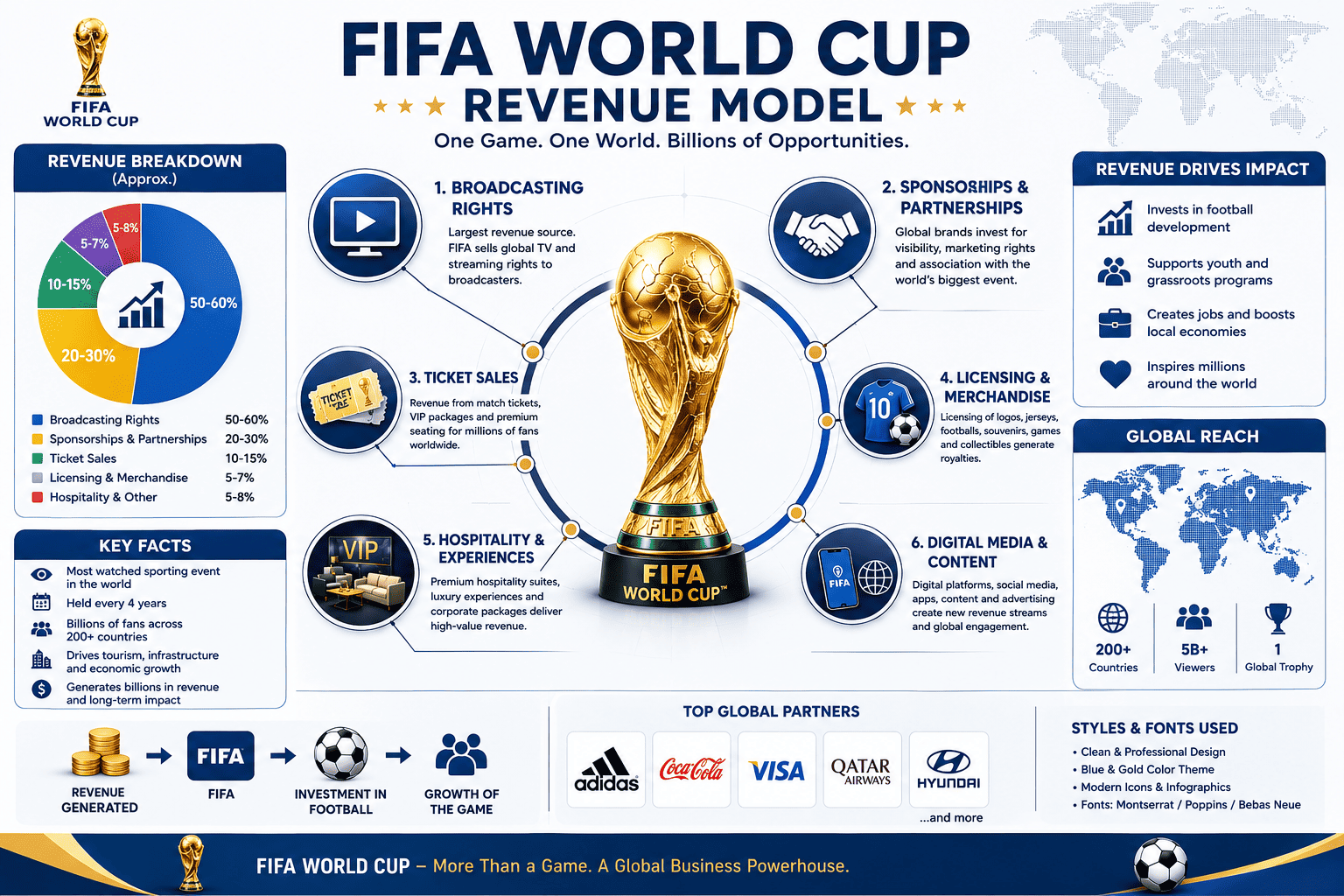
Discover how the FIFA World Cup generates billions through broadcasting, sponsorships, ticket sales, licensing, and global partnerships. Learn about FIFA World Cup history, business structure, earnings, FIFA World Cup prize money, and the organization behind the world’s biggest footballtournament.
Introduction
The FIFA World Cup is the world’s most prestigious football tournament and one of the largest sporting events ever organized. Every four years, billions of football fans watch their favorite national teams compete for the most coveted trophy in international football. Beyond the excitement on the pitch, the football world cup has become a billion-dollar global business that generates enormous revenue through broadcasting rights, sponsorships, ticket sales, licensing, hospitality, and digital media.
FIFA (Fédération Internationale de Football Association), the governing body of international football, has transformed the tournament into a worldwide commercial brand. Working closely with national governments, broadcasters, sponsors, and football associations, FIFA has created a sustainable business model that benefits the organization, participating nations, commercial partners, and millions of football fans.
Hosting the FIFA World Cup host country brings significant economic opportunities. Millions of visitors travel to the host nation, boosting tourism, hotels, transportation, retail, and local businesses. Governments invest in modern stadiums, airports, roads, and smart infrastructure, making the tournament one of the world’s largest event management projects.
As preparations continue for FIFA 2026 and the expanded World Cup 2026, the tournament is expected to reach even larger global audiences, demonstrating why the FIFA World Cup remains one of the most valuable sporting events in history.
FIFA World Cup History
The FIFA World Cup history began in 1930, when FIFA organized the first international football championship in Uruguay. Thirteen nations participated in the inaugural tournament, and Uruguay became the first-ever World Cup champion after defeating Argentina in the final.
The success of the first tournament encouraged FIFA to establish the World Cup as a regular international competition held every four years. However, the tournament was suspended during World War II, with no competitions held in 1942 and 1946.
After returning in 1950, the FIFA World Cup experienced tremendous growth. Television broadcasting introduced the tournament to millions of viewers worldwide, making football the most-watched sport on Earth. Technological advancements, satellite broadcasting, digital streaming, and social media have further expanded its global reach.
Several milestones have shaped the tournament’s history:
- 1930 – First FIFA World Cup held in Uruguay.
- 1958 – Brazil won its first title with football legend Pelé.
- 1970 – First World Cup broadcast in color television.
- 1998 – Tournament expanded from 24 to 32 teams.
- 2010 – South Africa became the first African FIFA World Cup host country.
- 2022 – Qatar hosted the first FIFA World Cup in the Middle East.
- 2026 – FIFA 2026 expands the competition to 48 participating nations, making the World Cup 2026 the biggest tournament in football history.
Today, the FIFA World Cup is watched by billions of people and remains one of the most valuable sporting properties in the world.
FIFA World Cup Business Structure
The FIFA World Cup operates through a carefully designed business structure that combines sports management, commercial partnerships, media rights, marketing, and large-scale event management. FIFA works with governments, broadcasters, sponsors, technology partners, and football associations to organize one of the most complex sporting events on Earth.
1. FIFA Governing Body
FIFA serves as the central governing organization responsible for planning, managing, and regulating every aspect of the tournament. It selects the FIFA World Cup host country, establishes competition rules, negotiates commercial agreements, manages broadcasting rights, and distributes revenue among its member football associations.
2. Host Country and Local Organizing Committee
After the FIFA Congress selects a host nation, the FIFA World Cup host country creates a Local Organizing Committee (LOC). This committee oversees stadium construction, transportation, accommodation, security, volunteer programs, fan zones, and overall event management to ensure a successful tournament.
3. Commercial Partners
Global brands invest hundreds of millions of dollars to become official FIFA sponsors. These companies receive worldwide exposure through stadium advertising, television broadcasts, official merchandise, digital campaigns, and fan engagement activities.
4. Broadcasting Partners
Television networks and streaming platforms purchase exclusive broadcasting rights to air FIFA World Cup matches. Broadcasting revenue remains FIFA’s largest income source because billions of viewers follow every match around the world.
5. Fans and Digital Platforms
Modern technology has transformed the fan experience through mobile apps, online ticketing, social media, fantasy football, digital collectibles, and live streaming. As FIFA 2026 approaches, FIFA continues investing in innovation to enhance fan engagement and increase global digital revenue.
6. Financial Strength of FIFA
The commercial success of the FIFA World Cup has made FIFA net worth and financial performance a topic of global interest. Revenue generated from broadcasting rights, sponsorships, licensing, ticket sales, and hospitality enables FIFA to invest in football development programs, youth competitions, women’s football, and infrastructure projects across its member football associations.
7. FIFA World Cup Prize Money
One of the tournament’s biggest attractions is the **FIFA
2nd Secret Code ‘ E ‘
3rd Secret Code – Meta Ads Guide for Facebook & Instagram Marketing
